

Key Steps in Navigating Personal Injury Claims
When a massive 18-wheeler collides with a passenger vehicle, the outcome is often devastating. The sheer size and weight of semi-trucks mean victims can suffer severe injuries, face huge medical bills, and endure lasting emotional trauma. Dealing with the aftermath can feel impossible, especially when powerful trucking companies and their insurers are involved.
This guide is here to help you. We will explain what to expect when you file a personal injury claim after an 18-wheeler or semi-truck accident. Understanding your rights and speaking with an experienced personal injury lawyer can help you make informed decisions when dealing with insurers, liability issues, and potential compensation. Our goal is to make the legal process clear and easy to understand so you know what steps may be available after a serious accident.
We will cover the common reasons these accidents happen. We will also look at who can be held responsible. You will learn about the types of compensation you can claim. We will also discuss how federal rules and key evidence play a big part in these cases. Understanding these complex matters, like those seen in Davies Hothem 18-wheeler claims, is vital.

Finally, we will answer common questions to give you the knowledge you need. This will help you protect your future after a serious truck accident.
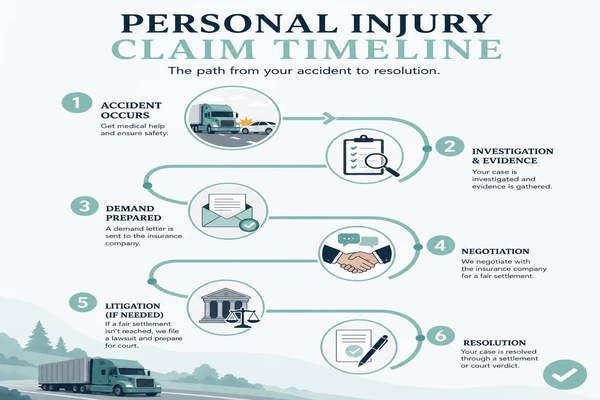
Navigating a personal injury claim after an 18-wheeler accident is a multi-faceted process that requires careful attention to detail and strategic action. From the moment of impact, every step taken can significantly influence the outcome of your case. Understanding this journey is crucial for victims seeking justice and fair compensation.
The path typically begins with immediate medical attention, followed by a thorough investigation, the drafting of a formal demand letter, and subsequent negotiations. If a fair settlement cannot be reached, the process may escalate to litigation, culminating in either a court settlement or a trial verdict. Each stage demands specific actions and expertise.
Initial Consultation and Case Evaluation
The very first step for many victims is to seek an initial consultation with an experienced personal injury attorney. During this crucial meeting, we will typically review the details of your accident, assess the extent of your injuries, and discuss the potential merits of your case. This is an opportunity for you to receive preliminary legal advice and understand your options.
A significant aspect discussed during this phase is the concept of contingency fees. Most reputable personal injury attorneys work on a contingency basis, meaning you pay no upfront legal fees. Instead, their payment is a percentage of the compensation they secure for you, whether through a settlement or a court award. This arrangement ensures that legal representation is accessible to everyone, regardless of their current financial situation.
Part of the evaluation involves estimating the potential case value. This is not a definitive figure but an informed assessment based on various factors, including the severity of your injuries, medical expenses incurred and anticipated, lost wages, and the clarity of liability. A skilled attorney will also help in accurately assessing liability, identifying all potentially responsible parties, which is often more complex in truck accident cases than in standard car accidents.
Gathering Critical Evidence for Personal Injury Claims
The strength of any personal injury claim hinges on the evidence collected. In the chaotic aftermath of an 18-wheeler accident, crucial evidence can be lost or compromised if not secured promptly. Our legal team emphasizes the immediate and meticulous gathering of all available information to build a robust case.
Key pieces of evidence include:
- Police Reports: These official documents provide an initial account of the accident, often including details about the scene, involved parties, witness information, and sometimes, a preliminary determination of fault.
- Witness Statements: Independent accounts from individuals who observed the accident can be invaluable. Their perspectives can corroborate your version of events and provide unbiased details that support your claim.
- Medical Records: Comprehensive medical documentation is paramount. This includes emergency room reports, diagnostic test results (X-rays, MRIs, CT scans), treatment plans, rehabilitation records, and prognoses. These records establish the extent and nature of your injuries, directly linking them to the accident.
- Scene Photos and Videos: Visual evidence captured at the accident site can be incredibly powerful. Photographs of vehicle damage, road conditions, skid marks, traffic signs, and injuries can vividly illustrate the circumstances of the crash. Dashcam footage, if available from your vehicle or others, can provide irrefutable proof of how the accident occurred.
- Trucking Company Records: Unlike regular car accidents, truck accidents involve a wealth of additional documentation. This includes the truck driver’s logbooks (or Electronic Logging Device data), maintenance records for the truck and trailer, inspection reports, driver qualification files, and company safety records. These documents can reveal violations of federal regulations, driver fatigue, or negligent maintenance, all of which can be critical in proving fault.
Securing this evidence quickly is vital. Trucking companies and their insurers often deploy rapid response teams to the scene to collect evidence that may benefit their defense, and some data, like black box information, can be overwritten if not preserved in time.
Understanding Liability and Fault in Commercial Vehicle Accidents
Determining liability in a commercial truck accident is often far more complex than in a typical car crash. The sheer number of parties involved in the operation and maintenance of an 18-wheeler means that fault can be distributed among several entities, not just the truck driver. Identifying all liable parties is critical to maximizing a victim’s compensation.
Proving Negligence in Complex Personal Injury Claims
To successfully pursue a personal injury claim, we must establish negligence. This involves demonstrating four key elements:
- Duty of Care: The responsible party (e.g., truck driver, trucking company) owed a legal duty to exercise reasonable care to prevent harm to others. For instance, a truck driver has a duty to operate their vehicle safely, and a trucking company has a duty to properly maintain its fleet.
- Breach of Duty: The responsible party breached that duty of care through their actions or inaction. This could involve a driver speeding, a company failing to inspect a truck, or a cargo loader improperly securing freight.
- Causation: The breach of duty directly caused your injuries and physical damages. There must be a clear link between the negligent act and the harm you suffered.
- Damages: You suffered actual damages as a result of the injuries, such as medical bills, lost wages, or pain and suffering.
In some states, a concept known as comparative fault comes into play. This means that if you are found to be partially at fault for the accident, your compensation may be reduced by your percentage of fault. For example, if you are awarded $100,000 but found 20% at fault, you would receive $80,000. If you are found to be more than 50% at fault in some jurisdictions (like Georgia), you may be barred from recovering any damages.
The Role of Federal Regulations and ELD Data
Federal regulations play an enormous role in semi-truck accident claims. The Federal Motor Carrier Safety Administration (FMCSA) sets stringent rules for commercial motor vehicles (CMVs) and their operators to enhance road safety. Violations of these regulations can be powerful evidence of negligence.
Key FMCSA guidelines include:
- Hours of Service (HOS): These rules dictate how long a truck driver can continuously drive and how much rest they must take. Driver fatigue is a major cause of truck accidents, and HOS violations are often central to proving negligence.
- Electronic Logging Devices (ELDs): ELDs automatically record a driver’s HOS, replacing traditional paper logbooks. This data is critical evidence, providing an objective record of a driver’s time behind the wheel, breaks, and duty status.
- Black Box Data (Event Data Recorders – EDRs): Similar to an airplane’s black box, EDRs in commercial trucks record vital information leading up to a crash, such as speed, braking, steering input, and engine performance. This data can confirm or refute a driver’s account of the accident.
- Maintenance Logs: FMCSA mandates regular inspections and maintenance for CMVs. Poorly maintained brakes, tires, or other critical components can lead to catastrophic failures. Maintenance logs reveal whether a trucking company adhered to these safety standards.
- Drug and Alcohol Testing: Commercial drivers are subject to strict drug and alcohol testing requirements. A positive test or refusal to test can indicate impairment as a contributing factor to an accident.
Securing and analyzing ELD data, black box data, and maintenance logs requires specialized knowledge and often the assistance of expert witnesses. These pieces of evidence are often time-sensitive, as some data can be overwritten after a short period (e.g., 30 days for ELD data, 72 hours for surveillance footage). This underscores the importance of retaining legal counsel quickly to issue preservation letters and ensure this critical evidence is not lost.
Common Causes of Commercial Truck Accidents
- Driver Fatigue (Hours of Service violations)
- Distracted Driving (cell phone use, eating)
- Speeding or Driving Too Fast for Conditions
- Impaired Driving (alcohol or drugs)
- Improper Truck Maintenance (brake failure, tire blowouts)
- Overloaded or Improperly Secured Cargo
- Inexperienced or Untrained Drivers
- Aggressive Driving or Road Rage
- Blind Spot Accidents (no-zones)
- Poor Weather Conditions
- Defective Truck Parts
- Roadway Defects
Types of Damages Recoverable in a Settlement
When you’ve been involved in an 18-wheeler accident, the financial implications can be overwhelming, extending far beyond immediate medical bills. A successful personal injury claim aims to recover comprehensive damages that cover all losses you’ve incurred and will continue to incur due to the accident.

These damages generally fall into two main categories: economic and non-economic.
- Medical Expenses: This includes all costs associated with your treatment, both past and future. This covers emergency room visits, ambulance fees, hospital stays, surgeries, doctor’s appointments, prescription medications, physical therapy, rehabilitation, medical devices, and even long-term care if necessary.
- Lost Wages: If your injuries prevent you from working, you can claim compensation for lost income. This includes wages you’ve already missed and projected future earnings if your ability to work is permanently diminished or you can no longer perform your previous job.
- Pain and Suffering: This category compensates you for the physical pain, emotional distress, mental anguish, and overall reduction in your quality of life caused by the accident. This is a non-economic damage and can be substantial, especially in cases involving catastrophic injuries.
- Property Damage: This covers the cost to repair or replace your vehicle and any other personal property damaged in the crash.
- Wrongful Death: In the tragic event that a loved one dies due to an 18-wheeler accident, surviving family members can pursue a wrongful death claim. This typically seeks compensation for funeral and burial expenses, loss of financial support, loss of companionship, and other related damages.
- Loss of Consortium: This applies to spouses of seriously injured victims, compensating them for the loss of companionship, affection, and other marital benefits due to their spouse’s injuries.
- Punitive Damages: In rare cases, if the at-fault party’s conduct was exceptionally reckless, malicious, or grossly negligent, a court may award punitive damages. These are not intended to compensate the victim but to punish the wrongdoer and deter similar conduct in the future.
Calculating the full extent of these damages, especially future medical costs and lost earning capacity, requires careful analysis, often involving economic and medical experts. An experienced attorney will work to ensure every potential damage is identified and accurately valued.
Damage Type Description Category Medical Bills Emergency care, hospital stays, surgeries, prescriptions, therapy, future medical needs. Economic Lost Wages Income lost from time off work, reduced earning capacity, loss of future income. Economic Property Damage Cost to repair or replace damaged vehicle and other personal property. Economic Pain and Suffering Physical pain, emotional distress, mental anguish, inconvenience, loss of enjoyment of life. Non-Economic Emotional Trauma PTSD, anxiety, depression, fear, shock, and other psychological impacts. Non-Economic Loss of Consortium Loss of companionship, affection, and other marital benefits for a spouse. Non-Economic Punitive Damages Awarded in cases of extreme negligence to punish the at-fault party and deter future misconduct. Punitive Frequently Asked Questions about Personal Injury Claims
Victims of 18-wheeler accidents often have many questions about the legal process. Here, we address some of the most common concerns regarding statute of limitations, dealing with insurance adjusters, and the critical role of legal representation in valuing and pursuing your claim.
What is the statute of limitations for filing a claim?
The statute of limitations is a strict legal deadline that dictates how long you have to file a personal injury lawsuit after an accident. This deadline varies significantly by state. For example, in Georgia, the general statute of limitations for personal injury claims is two years from the date of the accident. If you fail to file your lawsuit within this timeframe, you typically lose your right to seek compensation through the courts, regardless of the merits of your case.
There are some exceptions, such as the “discovery rule,” where the clock starts when you discover your injury, or exceptions for minors, where the deadline might be paused until they reach adulthood. However, these are complex legal nuances, and it is always best to consult with an attorney immediately to understand the specific filing deadlines applicable to your situation in June 2026.
How do insurance companies defend against these claims?
Trucking companies and their insurers are formidable opponents. They are well-resourced and employ sophisticated tactics to minimize payouts. Understanding their strategies can help you protect your rights:
- Blame-Shifting: Insurers often try to shift blame to the accident victim, claiming you were wholly or partially at fault to reduce or deny your compensation.
- Lowball Offers: They may contact you very early after the accident, offering a quick, seemingly generous settlement. However, these initial offers are almost always significantly lower than the true value of your claim, especially before the full extent of your injuries and long-term costs are known.
- Evidence Spoliation: While illegal, some trucking companies have been known to delay or even destroy critical evidence like driver logs, black box data, or maintenance records if not legally compelled to preserve them quickly.
- Minimizing Injuries: Adjusters may downplay the severity of your injuries, arguing they are pre-existing or not directly caused by the accident.
- Delay and Deny Tactics: They might intentionally prolong the claims process, hoping you’ll become frustrated and accept a lower settlement out of desperation.
It’s crucial to remember that insurance adjusters work for the trucking company, not for you. Their primary goal is to protect their employer’s bottom line.
Why should I hire an attorney instead of handling it myself?
Given the complexities and adversarial nature of truck accident claims, hiring an experienced attorney is not just beneficial-it’s often essential.
- Negotiation Power: An attorney brings significant negotiation power to the table. They understand the true value of your claim and are not intimidated by large insurance companies. They can counter lowball offers effectively and push for fair compensation.
- Trial Experience: While most cases settle out of court, having an attorney with trial experience signals to the insurance company that you are prepared to go to court if a fair settlement cannot be reached. This often leads to better settlement offers.
- Resource Access: Attorneys have access to a network of resources, including accident reconstructionists, medical experts, economists, and vocational rehabilitation specialists. These experts can provide critical testimony and analysis to strengthen your case.
- Evidence Preservation and Investigation: A lawyer will immediately launch an independent investigation, secure critical evidence (like black box data and driver logs), and issue preservation letters to prevent spoliation. They know what evidence is needed and how to obtain it.
- Legal Expertise: Truck accident law involves a deep understanding of federal regulations, state laws, and complex legal precedents. An attorney specializing in these cases can navigate these intricacies, ensuring no detail is overlooked.
- Focus on Recovery: By handling all legal aspects, your attorney allows you to focus on your physical and emotional recovery without the added stress of battling insurance companies and navigating legal procedures.
Trying to handle an 18-wheeler accident claim yourself against a well-funded trucking company and its legal team puts you at a severe disadvantage. An attorney levels the playing field and significantly increases your chances of securing the full and fair compensation you deserve.
Conclusion
Being involved in an 18-wheeler accident can be a life-altering event, leaving victims with profound physical, emotional, and financial burdens. While the journey to recovery and justice may seem daunting, understanding the process and having the right legal support can make all the difference.
We have explored the critical steps in navigating personal injury claims, from the initial consultation and meticulous evidence gathering to understanding complex liability issues and the role of federal regulations. We’ve also highlighted the various types of damages you can recover and addressed common questions that arise during this challenging time.
The trucking industry and its insurers are powerful entities. They will often act swiftly to protect their interests, making it imperative for accident victims to seek experienced legal counsel without delay. An attorney specializing in 18-wheeler accidents can be your advocate, ensuring that your rights are protected, evidence is preserved, and your claim is valued appropriately.
Pursuing a personal injury claim after a semi-truck accident is about more than just financial recovery; it’s about securing justice, holding negligent parties accountable, and gaining the peace of mind needed to rebuild your life. With dedicated legal advocacy, you can navigate these complexities and work towards a brighter future.