


Understanding Motion Practice in Family Law Proceedings
Navigating the complexities of family law and divorce can be emotionally and financially draining. During these challenging times, understanding the procedural tools available in litigation is crucial. One such tool, often misunderstood, is the Motion to Dismiss Example.
A motion to dismiss can significantly impact the trajectory of a family law case. It can potentially resolve disputes or narrow issues early on. This can save parties from unnecessary emotional and financial strain by challenging claims that lack legal merit or proper jurisdictional grounds.
From our 40+ years family law experience, we understand the critical role these motions play. We will demystify the concept of a motion to dismiss. We will explore its definition under legal rules, common grounds for filing one in family law, and how courts evaluate these arguments. We will also discuss strategic responses and practical lessons for those involved in divorce litigation. Our goal is to help you better understand this vital aspect of the legal process.
In the realm of civil litigation, including family law, a motion to dismiss serves as a powerful procedural tool that can halt a case in its tracks before it ever reaches trial. At its core, a motion to dismiss is a formal request made by one party (typically the defendant or respondent) to a court, asking the court to terminate the litigation or a specific claim within it because the plaintiff (or petitioner) has failed to meet certain legal requirements.

The most common ground for such a motion in federal courts is found under Federal Rule of Civil Procedure 12(b)(6), which allows for dismissal due to “failure to state a claim upon which relief can be granted.” Many state courts, including those handling family law matters, have analogous rules. When we refer to a “motion to dismiss example,” we are often looking at how this specific rule is applied.
A motion to dismiss under Rule 12(b)(6) is appropriate when, even if all the factual allegations in the complaint (or petition in family law) are taken as true, the law does not provide a remedy. It’s not about whether the plaintiff can prove their allegations, but whether those allegations, if proven, would legally entitle them to what they are asking for. For instance, in a divorce proceeding, if a petitioner files for divorce but fails to allege any legally recognized grounds for divorce as required by state statute, the respondent might file a motion to dismiss for failure to state a claim.
The purpose of this motion is to streamline litigation. It prevents cases from proceeding to discovery and trial when they are legally deficient from the outset. This can be a significant advantage in family law, where the emotional and financial costs of prolonged litigation are particularly high. For a deeper dive into the various types of motions and their purposes, you can explore resources like “When You Need the Judge to Decide an Issue File a Motion.”
While federal courts grant motions to dismiss in about 25-30% of cases overall, with higher rates in certain categories like civil rights, these statistics underscore the importance of proper pleading. In our practice, we’ve observed that approximately 70% of civil cases in U.S. federal district courts are resolved by motions to dismiss or summary judgment before trial. This highlights how critical it is for parties to understand these early-stage procedural mechanisms.
Common Grounds for a Motion to Dismiss Example in Domestic Relations
Beyond the overarching concept of “failure to state a claim,” there are several other common grounds upon which a party might seek to dismiss a case or a particular claim. These grounds are typically enumerated under Rule 12(b) of the Federal Rules of Civil Procedure and mirrored in state procedural rules. Understanding these distinct bases is crucial for anyone navigating domestic relations litigation.
The most common grounds for dismissal include:
- Lack of Subject Matter Jurisdiction (Rule 12(b)(1)): The court lacks the authority to hear the type of case presented.
- Lack of Personal Jurisdiction (Rule 12(b)(2)): The court lacks authority over the specific parties involved in the case.
- Improper Venue (Rule 12(b)(3)): The case has been filed in the wrong geographic location.
- Insufficiency of Process (Rule 12(b)(4)): There was a defect in the summons itself.
- Insufficiency of Service of Process (Rule 12(b)(5)): The summons and complaint were not properly delivered to the defendant.
- Failure to State a Claim Upon Which Relief Can Be Granted (Rule 12(b)(6)): Even if the facts alleged are true, they do not constitute a legal claim.
- Failure to Join a Required Party (Rule 12(b)(7)): A necessary party to the lawsuit has not been included.
While qualified immunity is a significant ground for dismissal in civil rights cases, particularly for government officials, it rarely applies directly to typical family law disputes between private parties. However, principles of standing and jurisdictional issues, as well as the failure to state a claim, are highly relevant.
For those looking to understand the structure and content of such motions, various templates are available. For instance, a “Federal Motion to Dismiss – 12(b)(6) | Free PDF & Word Template” provides a useful framework for federal cases, while a “State Court Motion to Dismiss – Colorado | Free PDF & Word Template” illustrates how these motions are adapted for state-specific procedural rules. These templates offer practical examples of how these grounds are articulated in legal filings.
Jurisdictional Challenges in Family Law Proceedings
Jurisdiction is the bedrock of a court’s authority. Without it, a court cannot legally hear a case or issue binding orders. In family law, jurisdictional challenges are particularly common and can arise in several forms.
Subject Matter Jurisdiction (Rule 12(b)(1)) refers to the court’s power to hear a particular type of case. Family courts, for example, have subject matter jurisdiction over divorce, child custody, child support, and adoption cases. If a party attempts to bring a claim that falls outside the court’s designated authority – for instance, trying to litigate a business dispute in family court – a motion to dismiss for lack of subject matter jurisdiction would be appropriate. This ground can be raised at any time during the proceedings, as it is never waived. Templates like the “Motion to Dismiss – Rhode Island | Free PDF & Word Template” often include sections addressing this critical jurisdictional requirement.
Personal Jurisdiction (Rule 12(b)(2)) concerns the court’s authority over the specific individuals involved in the case. For a court to exercise personal jurisdiction over a party, that party must have sufficient “minimum contacts” with the state where the court is located. This becomes especially relevant in family law when one spouse moves out of state, or when child custody or support issues involve parents residing in different states. For example, if a former spouse files a motion for increased child support in a state where the other parent has never lived and has no connections, the non-resident parent might successfully argue a lack of personal jurisdiction.
A critical piece of legislation governing interstate child custody disputes is the Uniform Child Custody Jurisdiction and Enforcement Act (UCCJEA). This act dictates which state has the authority to make initial child custody determinations, modify existing orders, and enforce orders from other states. Challenges based on the UCCJEA are essentially arguments about subject matter jurisdiction in the context of child custody. A parent might file a motion to dismiss a custody petition if the filing state is not the child’s “home state” as defined by the UCCJEA. The “Motion to Dismiss – Wisconsin | Free PDF & Word Template” demonstrates how jurisdictional arguments are structured in a state court setting, which can be adapted for UCCJEA challenges.
Understanding these jurisdictional nuances is vital. A successful jurisdictional challenge can lead to the dismissal of a case, requiring it to be refiled in the proper court, or preventing the court from issuing orders against a party over whom it lacks authority.
Failure to State a Claim in Family Law Proceedings
The ground of “failure to state a claim upon which relief can be granted” (Rule 12(b)(6) in federal court, or its state-level equivalent) is a common and often successful basis for a motion to dismiss. This challenge doesn’t dispute the facts alleged by the opposing party; instead, it argues that even if those facts are true, they do not legally entitle the party to the relief they are seeking.
The legal standard for evaluating a 12(b)(6) motion has evolved significantly. In 2007 and 2009, the U.S. Supreme Court’s decisions in Bell Atlantic Corp. v. Twombly and Ashcroft v. Iqbal, respectively, established a “plausibility standard.” This standard requires a complaint to contain “sufficient factual matter, accepted as true, to state a claim to relief that is plausible on its face.” This means that merely making conclusory statements or reciting the elements of a cause of action is not enough. Instead, the pleading must include enough factual detail to allow a court to reasonably infer that the defendant is liable for the misconduct alleged.
In the context of family law, this “plausibility standard” means that a petition or motion must do more than just assert a desire for a particular outcome. For example:
- Divorce Petitions: If a state requires specific grounds for divorce (e.g., irreconcilable differences, adultery, cruelty), a petition that simply states “I want a divorce” without alleging any of these grounds, or providing factual support for them, could be subject to dismissal.
- Motions for Support: A motion seeking spousal support or child support must typically allege facts demonstrating the need for support and the other party’s ability to pay, according to statutory factors. A bare request for support without any factual basis might fail the plausibility test.
- Custody Disputes: While courts prioritize the best interests of the child, a motion seeking a change in custody must still allege facts showing a material change in circumstances or that the current arrangement is no longer in the child’s best interest. Conclusory statements about a parent’s unsuitability without supporting facts would likely be challenged.
When facing such a motion, the court accepts all well-pleaded factual allegations as true and construes them in the light most favorable to the non-moving party. However, legal conclusions masquerading as facts are disregarded. The ultimate question is whether the complaint, read as a whole, presents a “plausible” claim for relief.
For a practical understanding of how these arguments are structured, a “Standard to Dismiss Complaint Failure to State Claim” memorandum provides an example of the legal reasoning involved. Additionally, a “Sample Motion to Dismiss Template” offers a blueprint for drafting such a motion, demonstrating how to articulate the legal standard and apply it to the facts (or lack thereof) in the complaint. Effectively leveraging this ground can lead to an early and efficient resolution of legally deficient claims.
Strategic Responses and Early Endgames in Divorce Litigation
When a motion to dismiss is filed in a family law case, it presents a critical juncture. For the party whose pleading is being challenged, a strategic and well-reasoned response is paramount to avoid dismissal at this early stage. This is where the intricacies of responsive pleadings and litigation strategy truly come into play.
A plaintiff or petitioner facing a motion to dismiss must typically file an opposition brief, arguing why their complaint or petition does meet the required legal standards. This involves:
- Reiterating Factual Sufficiency: Demonstrating that the complaint contains enough factual allegations to satisfy the plausibility standard set by Twombly and Iqbal, even if those facts are disputed.
- Addressing Legal Arguments: Directly refuting the defendant’s legal arguments, explaining why the claims are legally sound and why the court has jurisdiction.
- Requesting Leave to Amend: If there are technical deficiencies in the pleading, it is often prudent to request leave from the court to amend the complaint. Courts are generally liberal in granting leave to amend, especially if it’s the first time the pleading is being challenged, to allow parties to cure defects rather than dismiss the case outright. This is a crucial “safety net” for plaintiffs.
The goal of a successful motion to dismiss, for the moving party, is to achieve an “early endgame.” If the motion is granted, the case (or certain claims within it) is dismissed, potentially saving significant time, emotional distress, and legal fees. This aligns with the strategic approach we emphasize when setting the stage for your divorce litigation, where early assessment and decisive action can shape the entire trajectory of the case. For example, in Middlesex County Superior Court, dismissals can occur at various stages, highlighting the importance of addressing deficiencies promptly.
Conversely, for the non-moving party, a successful opposition means the case proceeds, often bolstering their position by confirming the legal viability of their claims. This early win can set a positive tone for subsequent negotiations or trial proceedings.
The statistics on motion success rates underscore the strategic importance of these filings. While motions to dismiss in civil rights cases in the Sixth Circuit (where the Reynolds v. Williamston case, mentioned in the research, was filed) are granted in approximately 35% of cases, the overall federal success rate is around 25-30%. These figures illustrate that while not always successful, motions to dismiss are a significant hurdle that many cases face. Thorough preparation and an understanding of the legal standards are essential, whether you are filing or responding to such a motion.
Frequently Asked Questions about Family Law Motions
Navigating the procedural landscape of family law can raise many questions. Here, we address some common inquiries regarding motion practice in domestic relations cases.
What is the difference between a motion to dismiss and summary judgment?
While both motions aim to resolve a case before trial, they operate at different stages and on different legal bases.
- Motion to Dismiss (e.g., Rule 12(b)(6)): This motion typically occurs very early in the litigation, before discovery has taken place. It challenges the legal sufficiency of the pleadings themselves. The court assumes all factual allegations in the complaint are true and asks: “Do these alleged facts, if proven, constitute a valid legal claim?” No outside evidence is generally considered for a 12(b)(6) motion.
- Motion for Summary Judgment (e.g., Rule 56): This motion usually occurs after discovery has been completed. It challenges the evidence in the case. The court asks: “Is there any genuine dispute as to any material fact, and if not, is the moving party entitled to judgment as a matter of law based on the undisputed facts?” Here, the court reviews evidence such as depositions, affidavits, and documents.
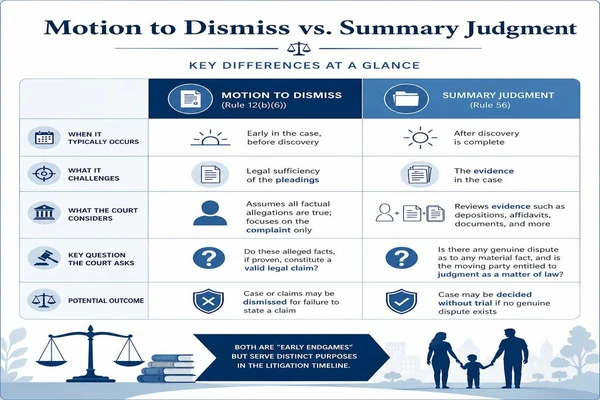
Here’s a table comparing the two:
As the “What Is the Difference Between a Motion To Dismiss… – Ansell.Law” article explains, both are “early endgames” but serve distinct purposes in the litigation timeline.
How do courts evaluate standing and injury-in-fact in domestic cases?
Standing is a fundamental requirement for bringing a lawsuit, ensuring that only parties with a genuine stake in the outcome can litigate. To establish standing, a plaintiff (or petitioner in family law) must demonstrate three elements:
- Injury-in-Fact: The plaintiff must have suffered an invasion of a legally protected interest that is (a) concrete and particularized, and (b) actual or imminent, not conjectural or hypothetical.
- Causation: There must be a causal connection between the injury and the conduct complained of.
- Redressability: It must be likely, not merely speculative, that a favorable court decision will remedy the injury.
In domestic cases, the “injury-in-fact” element is crucial. Courts evaluate whether a party has alleged a concrete and particularized injury versus a hypothetical or conjectural one. For example, in custody cases, a non-parent seeking custody might need to demonstrate a specific, concrete harm to the child or an established parental unfitness to have standing. Simply alleging a general disagreement with a parent’s choices, without showing actual harm or a direct impact on the child’s well-being, might be deemed a hypothetical injury insufficient for standing. The U.S. Supreme Court’s decision in Lujan v. Defenders of Wildlife is a seminal precedent establishing these stringent requirements for injury-in-fact.
Similarly, a party might lack standing if they challenge a potential future enforcement of a court order without any specific incident or actual application of that order against them. The harm must be actual or imminent, not merely speculative.
What should I expect if my family law case goes to trial?
If a motion to dismiss is denied, it means the court believes the case has legal merit and should proceed. This often leads to the discovery phase, where parties exchange information and gather evidence, potentially culminating in a trial.
Going to trial in a family law case can be an intensive process. You should expect:
- Evidentiary Hearings: The court will hear testimony from witnesses, including the parties themselves, experts (such as child psychologists or financial analysts), and other relevant individuals.
- Presentation of Evidence: Documents, financial records, photographs, and other tangible evidence will be presented to support each party’s claims.
- Judicial Decisions: Unlike civil trials that often involve juries, family law trials are typically decided by a judge. The judge will make findings of fact and conclusions of law on all contested issues, including child custody, visitation schedules, child support, spousal support, and the division of marital assets and debts.
- Thorough Preparation: Success at trial hinges on meticulous preparation, including organizing evidence, preparing witnesses, and understanding the legal arguments.
While the prospect of trial can be daunting, understanding the process can help alleviate some anxiety. Our resources, such as “My Case is Going to Trial What Should I Expect,” “The Divorce Process Guide,” and “Your Divorce Start to Finish,” offer comprehensive insights into preparing for and navigating this phase of your family law journey.
Conclusion
The motion to dismiss, while a technical legal instrument, plays a profoundly practical role in family law and divorce proceedings. It represents an early opportunity to challenge the legal foundation of a claim, potentially saving parties from prolonged and often emotionally taxing litigation. From jurisdictional challenges concerning where a case can be heard, to arguments about whether a petition sufficiently states a claim for relief, understanding these motions is crucial for any party involved in domestic relations.
Whether you are considering filing a motion to dismiss or are responding to one, the intricacies of procedural rules, the plausibility standards, and the nuances of standing require careful attention. The stakes in family law are uniquely personal, affecting not only financial well-being but also the lives of children and the emotional health of all involved.
Given these complexities, seeking experienced legal counsel is not just advisable, but often essential. A skilled attorney can assess the merits of a potential motion to dismiss, draft compelling arguments, and guide you through the strategic decisions that can significantly influence the outcome of your case. By understanding and effectively utilizing or responding to a motion to dismiss, parties can navigate their family law proceedings with greater clarity and purpose, ultimately striving for a more efficient and just resolution.