

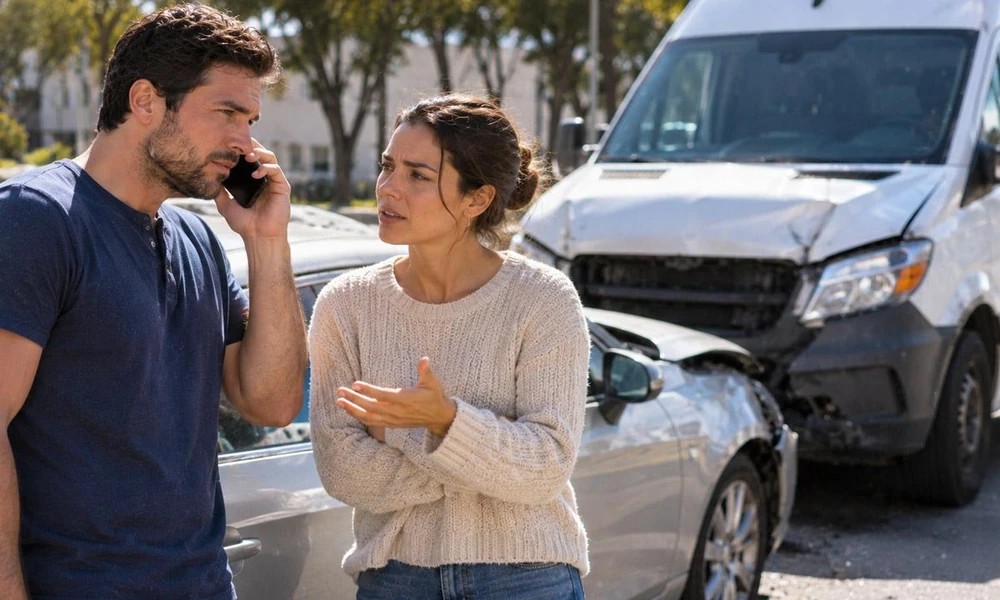
If a delivery driver hits you in Ontario, the driver may not be the only one who pays. An employer is usually responsible for an employee’s on-the-job driving. Amazon and FedEx Ground use contractor companies, so the right defendant may be a business you never heard of. Gig drivers for apps like DoorDash fall under Prop 22, which requires at least $1 million in liability coverage during active deliveries. Act fast: evidence disappears.
You were driving through Ontario, and a delivery van ran a light, cut across your lane, or rear-ended you while the driver checked a route screen. If you are now searching for a delivery truck accident lawyer, you probably have one big question. Who actually pays for this?
The answer is rarely simple. The van might say “Amazon” on the side, but the driver might work for a small contractor. Or the driver might be a gig worker in a personal car. Each setup points to a different insurance policy, and every company in the chain wants to point at someone else.
Here is the truth: big delivery companies built their business models around contracts and paperwork. Those structures can shift who is liable. They do not erase your right to be paid for your injuries.
This guide covers who can be held responsible, which insurance applies, and what evidence matters most after an Ontario delivery van accident.
Who Pays After an Ontario Delivery Van Accident?
In most cases, the driver who caused the crash is responsible, and so is the company that employed them if they were working at the time. California law calls this respondeat superior. The real fight is usually over who the employer is and whether the driver was “on the job” when the crash happened.
The Basic Rule: Employers Answer for On-the-Job Driving
“Respondeat superior” is Latin for “let the master answer.” In plain English, an employer is liable for harm its employee causes while doing the job. You do not have to prove the company did anything wrong itself.
This matters because individual drivers often carry modest insurance. A company usually carries much more.
Why “Working at the Time” Is the Key Question
The rule only applies if the driver was acting within the scope of employment. A driver on an assigned route is usually covered. A driver running a personal errand after clocking out may not be, so expect the company to argue exactly that.
Amazon, FedEx, and the Contractor Shell Game
Many branded delivery vans are not driven by the brand’s own employees. Amazon and FedEx Ground both contract with independent businesses that hire their own drivers. That usually means your claim starts with the contractor and its insurance, while a lawyer looks hard at whether the big company shares the blame.
Amazon’s Delivery Service Partner Model
Amazon’s Delivery Service Partner (DSP) program pays small business owners to handle last-mile delivery. According to a U.S. Chamber of Commerce feature on the program, DSP owners recruit and manage their own teams of delivery associates. Amazon offers them deals on Amazon-branded vans and insurance options.
So a blue Amazon van driver may work for a DSP, not for Amazon. An Amazon executive told Insurance Journal that DSPs are independent businesses and are not required to buy the insurance Amazon offers through its program. The DSP’s commercial policy is usually the first place to check.
A logo on a van tells you who sells the packages, not who signs the driver’s paycheck.
FedEx Ground’s Service Provider Model
FedEx Ground works in a similar way. Its contractor FAQ page says it contracts with independent businesses that employ their own personnel. It also says service providers are responsible for getting their insurance, while FedEx keeps its own public liability coverage.
So a FedEx Ground crash claim usually names the service provider. Whether FedEx itself can be pulled in depends on how much control it had over the driver and route.
Employee or Independent Contractor? A Word on AB 5
Companies label workers “independent contractors” to limit liability. California’s AB 5 (2019) made that harder by requiring the hiring business to prove a worker is truly independent.
If the driver is really an employee, respondeat superior can apply. This is one of the first things a skilled delivery truck accident lawyer investigates.
Gig Drivers, Personal Cars, and Prop 22
When a DoorDash, Uber Eats, or Amazon Flex driver hits you in their own car, two policies may apply: the driver’s personal auto policy and the app company’s coverage. California’s Prop 22 requires delivery network companies to carry at least $1 million in liability coverage for crashes during “engaged time.”
The Personal Policy Problem
Many personal auto policies include a business-use exclusion, which means the policy may not cover driving for pay. The driver’s insurer may deny your claim the moment it learns the driver was delivering food. That is the gap Prop 22 helps fill.
What Prop 22 Actually Requires
California voters passed Proposition 22 in 2020, and the California Supreme Court upheld it in Castellanos v. State of California in 2024. Under Business and Professions Code section 7455, delivery network companies must carry at least $1 million per occurrence in auto liability coverage for injuries caused by a driver during engaged time.
“Engaged time” generally refers to the period from when a driver accepts a delivery until they complete it. If the vehicle already has a policy meeting California’s standards, that policy may come first. Prop 22 also requires occupational accident insurance, but that protects the driver, not you. Exact timing can decide which policy pays, and the app company controls that data.
Other Ways a Company Can Be on the Hook
Even when the superior’s response does not apply, a delivery company may still be liable for its mistakes. These claims focus on what the company itself did wrong, not just the driver.
Negligent Hiring, Retention, and Supervision
A company can be liable if it hired a driver it knew (or should have known) was dangerous, like someone with past DUIs. The same goes for keeping a driver after repeated complaints, or failing to supervise unsafe driving.
These claims often require internal records that companies do not hand over without a fight.
Owner Liability for Borrowed Vehicles
Sometimes the driver is using a car owned by someone else. Under Vehicle Code section 17150, a vehicle owner can be liable when someone drives with permission. But section 17151 caps that owner liability at $15,000 for one person’s injury, $30,000 per accident, and $5,000 for property damage.
Those caps do not apply to employer liability. That is one more reason the employer question matters so much.
What a Delivery Truck Accident Lawyer Does With the Evidence
Delivery vans are rolling data centers. Telematics, dashcams, and route logs can show speed, braking, phone use, and exactly where the driver was supposed to be. A delivery truck accident lawyer moves fast to demand that companies save this evidence before it is overwritten or deleted.
The Digital Trail
Many delivery fleets use telematics, systems that record speed, location, and sudden braking. Some vans have cameras, and handheld scanners log every stop.
This data can prove the driver was on the clock and driving carelessly, which blows up the “off duty” defense.
The Company’s Duty to Preserve Evidence
Once a company knows a claim is coming, it has a legal duty to preserve relevant evidence. A preservation letter puts them on notice, and destroying evidence after that can bring serious court penalties.
The company has the footage, the data, and the logs. Make them keep it.
Ontario Roads, Deadlines, and Fault Rules
Ontario sits at the center of one of the busiest logistics hubs in the country. Ontario International Airport (ONT) handles major cargo traffic, and warehouses line the I-10, I-15, and SR-60 corridors. In 2022, FOX 11 reported that Amazon was building a massive facility at the Merrill Commerce Center in Ontario.
The California Office of Traffic Safety’s 2023 rankings for Ontario placed the city 31st out of 62 similar-sized cities for fatal and injury crashes (where 1 is worst).
Getting the Police Report
Crashes on Ontario city streets are generally handled by the Ontario Police Department, the city’s own force. Freeway crashes usually go to the California Highway Patrol.
Comparative Fault and the Two-Year Clock
California uses pure comparative fault. If you were partly to blame, your compensation goes down by your share, but you can still recover. Insurers love to inflate your share.
You generally have two years from the injury date to file a personal injury lawsuit under Code of Civil Procedure section 335.1. Claims against government vehicles have much shorter deadlines.
Making Delivery Companies Own Their Crashes
Delivery giants built layers of contractors and app terms between themselves and the people their drivers hurt. Those layers make claims harder, not hopeless. The driver, the contractor, the app company, or the brand may all be responsible.
If you were hurt by a delivery driver anywhere in the Inland Empire, our Ontario office at 3200 E Guasti Road is minutes from ONT. Learn more about our car accident cases, San Bernardino car accident claims, and catastrophic injury representation.
Been in an accident or hurt on the job? You don’t have to navigate insurance companies alone. Oracle Law Firm fights to get you the compensation, control, and clarity you deserve.
Get a Free Consultation or call 888.597.4099.
Legal disclaimer: This article is for general information only and is not legal advice. Every case depends on its specific facts, and reading this does not create an attorney-client relationship. Past results do not guarantee future outcomes.
Frequently Asked Questions
Can I sue Amazon if an Amazon delivery van hit me?
Possibly, but most Amazon-branded vans are driven by employees of Delivery Service Partners, which are independent companies. Your claim usually starts against the driver and the DSP. Whether Amazon can also be held responsible depends on the facts, including how much control it had over the driver.
Who pays if a DoorDash or Uber Eats driver hits me?
It depends on what the driver was doing at the time. Under California’s Prop 22, app-based delivery companies must carry at least $1 million in liability coverage for crashes during engaged time, meaning while a delivery is accepted and in progress. The driver’s personal policy may also apply, though many exclude business use.
What is a respondeat superior?
Respondeat superior is a legal rule that makes an employer responsible for harm its employee causes while doing their job. You do not need to prove the employer did anything wrong itself. The key questions are whether the driver was an employee and whether they were working when the crash happened.
How long do I have to file a claim after a delivery van accident in California?
Most personal injury lawsuits in California must be filed within two years of the injury. Claims involving government vehicles have much shorter deadlines. Evidence like dashcam footage and telematics data can disappear much sooner, so it is smart to act quickly.
What if I was partly at fault for the delivery van crash?
California uses pure comparative fault, so you can still recover money even if you share some blame. Your compensation is reduced by your percentage of fault. Insurance companies often try to push more blame onto you, so avoid admitting fault or guessing about the crash.